Abstract
This study explores emotional expression and engagement dynamics within Reddit communities, focusing on how users convey negative emotions and how these evolve across posts, comments, and replies. Using word analysis, sentiment analysis, and emotion detection, we analyze nine datasets: seven subreddits focused on mental health and negative emotions (e.g., r/Stress, r/mentalhealth) and two keyword-filtered sets of posts from a general university community (r/uofm). Posts often expressed sadness or anger, while comments and replies shifted toward positivity, with joy dominating in most subreddits. r/Stress and r/uofm displayed strong supportive engagement, emphasizing solution-oriented interactions. In contrast, subreddits like r/angry and r/sadcringe maintained higher levels of anger, reflecting the thematic focus of these communities. Our methods combine TextBlob for sentiment analysis, a pre-trained DistilBERT model for emotion detection, and an exploratory comment classifier built on Sentence-BERT embeddings. The findings show how community responses can shift the emotional tone of a thread, and they can inform the design of supportive online spaces.
1. Introduction
Online platforms like Reddit have become significant spaces for individuals to discuss mental health and share everyday stresses. These anonymous forums provide users with opportunities to seek support, share experiences, and connect with others facing similar challenges. Subreddits, which are dedicated communities within Reddit, cater to specific audiences and interests, ranging from general mental health discussions to stress management and academic concerns.
Understanding how users express emotions and sentiments within these online spaces is crucial for identifying community-specific needs and tailoring mental health interventions. Insights gained from analyzing these discussions can inform strategies to foster supportive and empathetic environments, both online and offline. In this report, we explore the linguistic and emotional dimensions of posts, comments, and replies across several mental health-related subreddits.
Our analysis has two primary research questions:
RQ1: How do users across subreddits vary in expressing emotions and themes, and what insights can keyword and sentiment analysis reveal about community-specific dynamics?
RQ2: How does participating in subreddit discussions focused on negative emotions influence users' sentiment, emotional tone, and engagement patterns over time?
To answer these questions, we combine word frequency analysis, sentiment scoring, emotion detection with a pre-trained model, a custom comment classifier, and tracking of users' activity over time. Together these let us compare emotional tone across content types and subreddits.
2. Related Work
In this section, we begin by reviewing existing research on analyzing Reddit data to uncover behavioral patterns, followed by an exploration of social online engagement and its connection to mental health.
2.1 Behavioral Patterns through Reddit Data
Reddit has long been used as a platform to explore collective user behaviors across various contexts. Thukral et al. (2018) systematically analyzed large-scale behavioral trends, identifying phenomena like “Mayfly Buzz” in highly active but short-lived posts [1]. This early work provides foundational insights into user dynamics but does not address health-related or emotional contexts. Proferes et al. (2021) later reviewed 727 studies using Reddit, showcasing its growing role in interdisciplinary research and underscoring ethical considerations in using platform data [2].
Further exploring specific behaviors, Urbaniak et al. (2022) analyzed the correlation between username toxicity and harmful behavior, while Record et al. (2018) examined health information-seeking, finding that users actively searching for health-related content are more likely to act on it [3, 4]. Ribeiro et al. (2024) introduced “post guidance,” a proactive moderation strategy that enhances content quality and user engagement without adding burdens on moderators [5]. Guo et al. (2023) studied engagement in online critique communities, showing how feedback characteristics and the stage of the creator's work influence responses [6]. Together, these studies highlight the versatility of Reddit for behavioral analysis and motivate our investigation into emotional and engagement patterns within stress and mental health-related contexts, addressing gaps in the understanding of supportive online communities.
2.2 Online Social Engagement and Mental Health
With the advancement of technology, online platforms have become vital spaces for social engagement and mental health support. Research has demonstrated the potential of social media for understanding and addressing mental health issues. Ayyalasomayajula et al. (2024) utilized linguistic analysis and machine learning techniques, such as logistic regression with enhanced TF-IDF features, to predict depression from Reddit posts, highlighting the role of language in identifying mental health states [7]. However, these algorithmic approaches also raise ethical challenges, as discussed by Chancellor et al. (2019), who proposed a taxonomy of tensions related to privacy and potential misuse in inferring mental health states from social media [8].
Beyond prediction, the role of social support in online communities has been a focal point. Chiu et al. (2015) examined online community citizenship behaviors (OCCB), showing that social support and social identity positively influence behaviors that benefit the community as a whole [9]. Similarly, Sharma and De Choudhury (2018) explored how linguistic accommodation within these communities enhances social feedback and support, emphasizing the importance of conforming to community norms for effective engagement [10]. Chen and Xu (2021) further extended this direction by showing that social support in online mental health Reddit communities is “contagious,” with users who receive positive support being more likely to offer support to others, creating a chain reaction [11]. Together, these studies underscore the multifaceted nature of social engagement in online mental health communities, from predictive modeling and ethical concerns to the transformative effects of social support on individual and collective well-being.
3. Data and Methods
To examine the emotional and linguistic patterns in Reddit communities, we combined word frequency analysis, sentiment analysis, emotion detection, comment classification, and temporal activity tracking. This section describes each method and the reasoning behind its selection.
3.1 Data Collection
Reddit is a widely used online platform where users can create posts or comment on existing ones. Posts are organized into specific communities called “subreddits,” each defined by its name and description, which outline the community's focus. For this study, we analyzed 7 subreddits related to mental health and negative emotions (also referred to as OMHCs, online mental health communities), plus, as a comparison case, posts mentioning “stress” or “mental health” from r/uofm, a university community that is not dedicated to mental health.
3.1.1 Subreddit selection
In order to capture a representative subreddit group, we selected the 8 negative emotion words with highest psychocultural salience across the Anglo group [12]: sad, angry, depressed, anxious, confused, frustrated, exhausted, hate. After checking the related subreddit names and prioritizing the ones with more members, we finally selected r/sadcringe (1.3M), r/angry (7.1k), r/depression (1.1M), r/Anxiety (731k), and r/confusing (11k). We excluded frustrated, exhausted, and hate because there was either no closely relevant subreddit or the community was too small (r/Frustration, 311 members; r/Exhaust, 908 members). We also complemented the subreddit groups with two more active subreddits: r/mentalhealth (506k) and r/Stress (21k). In addition to exclusive OMHCs, we included r/uofm as a comparison to explore potential differences in community dynamics.
3.1.2 Data Fetching
We utilized the Python Reddit API Wrapper (PRAW) to collect data. For each subreddit, we retrieved the latest posts using the method reddit.subreddit(target_subreddit).new(limit=1000) along with the corresponding comments and replies. However, due to API limitations and community-specific policies, we were not always able to fetch the full 1,000 posts for each community. For r/uofm, we instead retrieved posts by keyword search: reddit.subreddit(target_reddit).search(query, limit=limit). The term uofm_stress refers to posts retrieved using the keyword “stress,” while uofm_mh refers to posts retrieved using the keyword “mental health.”
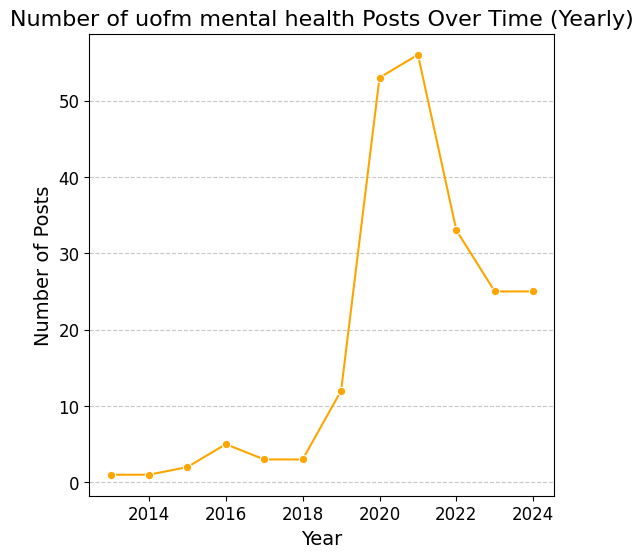
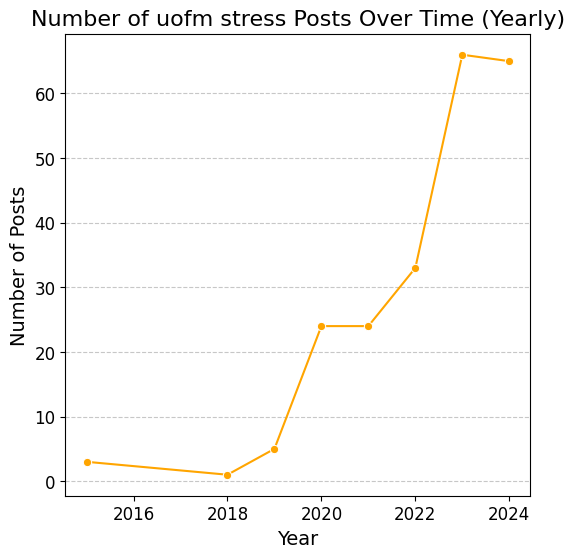
Table 1 summarizes the number of posts retrieved, the unique users involved as either commenters or original posters (OPs), and the average number of words in the title and post selftext. Figure 1 depicts the trend of r/uofm posts over time.
| Subreddit | #Posts | #Unique Users | #Words in Title + Selftext |
|---|---|---|---|
| r/sadcringe | 638 | 20633 | 16.75 |
| r/angry | 975 | 1210 | 162.86 |
| r/depression | 993 | 1961 | 179.23 |
| r/Anxiety | 975 | 1210 | 162.86 |
| r/confusing | 843 | 2332 | 27.89 |
| r/Stress | 966 | 1378 | 169.11 |
| r/mentalhealth | 987 | 1950 | 214.52 |
| uofm_stress | 221 | 1650 | 206.59 |
| uofm_mh | 219 | 1395 | 250.17 |
Table 1: Descriptive statistics of fetched subreddit data.
3.2 Community-based Analysis
3.2.1 Word Analysis
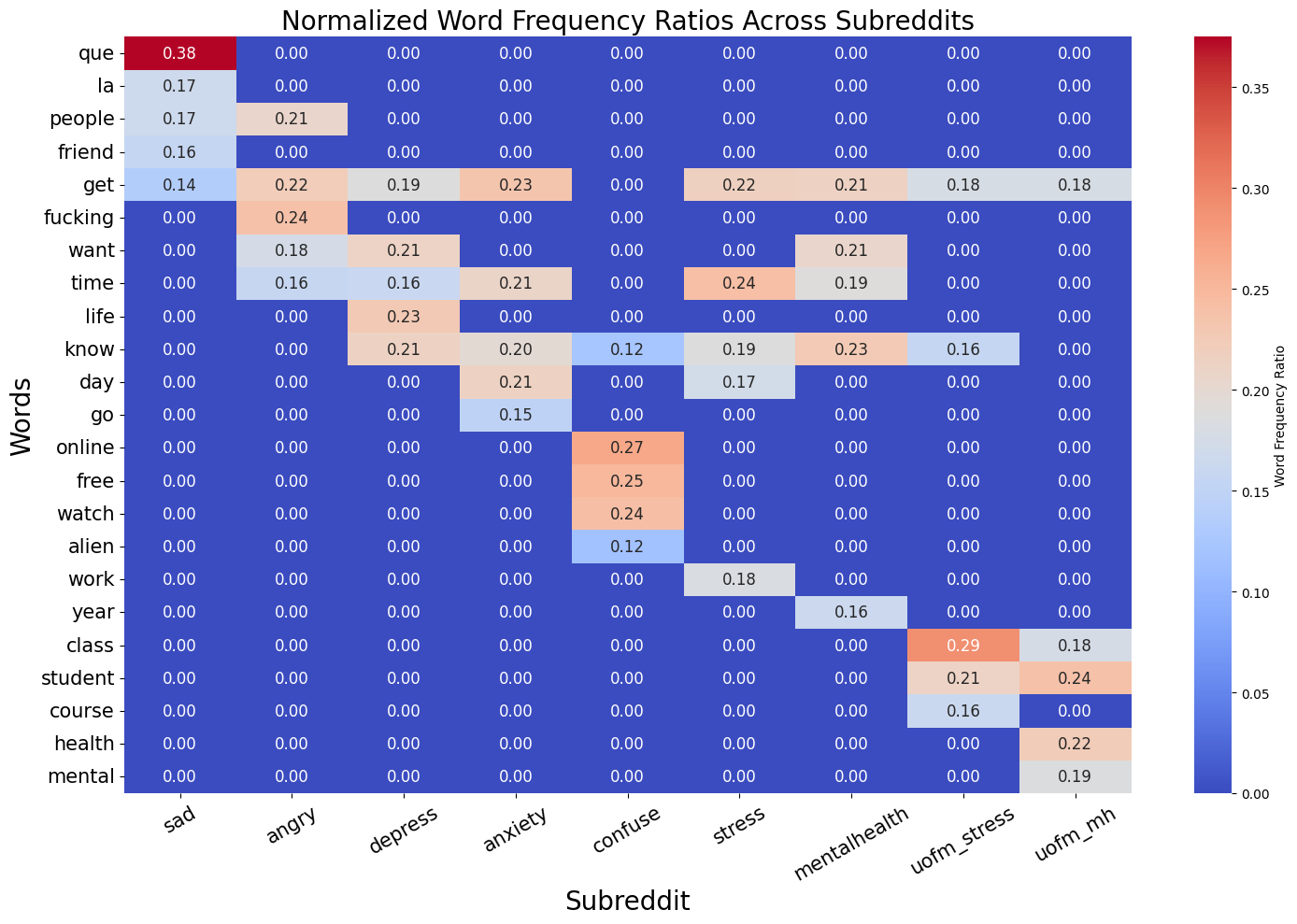
To analyze the thematic content of posts across subreddits and reveal how users depict themselves in group conversation, we extracted and lemmatized words from post self-texts, removing common stopwords as well as subreddit-specific terms (e.g., “stress,” “anxiety,” “reddit”) to focus on meaningful and relevant content (see Appendix A.3 for the full removal list). For each subreddit, we collected the 5 most frequent words to provide insights into the thematic focus of each community. Additionally, we normalized word frequencies within each subreddit to calculate relative ratios among all frequent words and created a heatmap to compare the normalized word distributions across communities. This heatmap highlights differences in word usage patterns and provides a broader perspective on thematic variations between subreddits.
3.2.2 Sentiment Analysis
For sentiment analysis, we employed the TextBlob library (Loria, S., n.d.), a tool that computes sentiment polarity scores ranging from −1 (negative sentiment) to +1 (positive sentiment). We selected TextBlob for its simplicity and its established use on user-generated content such as Reddit posts and comments. By averaging these scores across posts, comments, and replies, we were able to compare the overall tone across subreddits.
3.2.3 Emotion Detection
To delve deeper into emotional expressions, we used the pre-trained Hugging Face model distilbert-base-uncased-emotion (Savani, B., n.d.). This model is a distilled version of BERT (Bidirectional Encoder Representations from Transformers) and was fine-tuned specifically for emotion classification, making it computationally efficient. It classifies text into six emotion categories (joy, sadness, anger, fear, surprise, and love), which suits our goal of comparing emotional dynamics. We chose it for its balance of speed and performance. The outputs were aggregated by subreddit and content type.
3.2.4 Comment Analysis
Comments are where community responses happen, so we also examined what kind of response each comment offers. We defined four comment types based on a comment's contribution to the conversation: suggestion, empathy, neutral, and negative. No pre-trained model fit this scheme, and labeling every comment with a large language model (LLM) would have been costly, so we used an LLM to label a small sample and trained a lightweight classifier on those labels. The procedure had four steps:
- We flattened the comments from all subreddits and randomly selected 200 samples, including the corresponding post titles and self-texts.
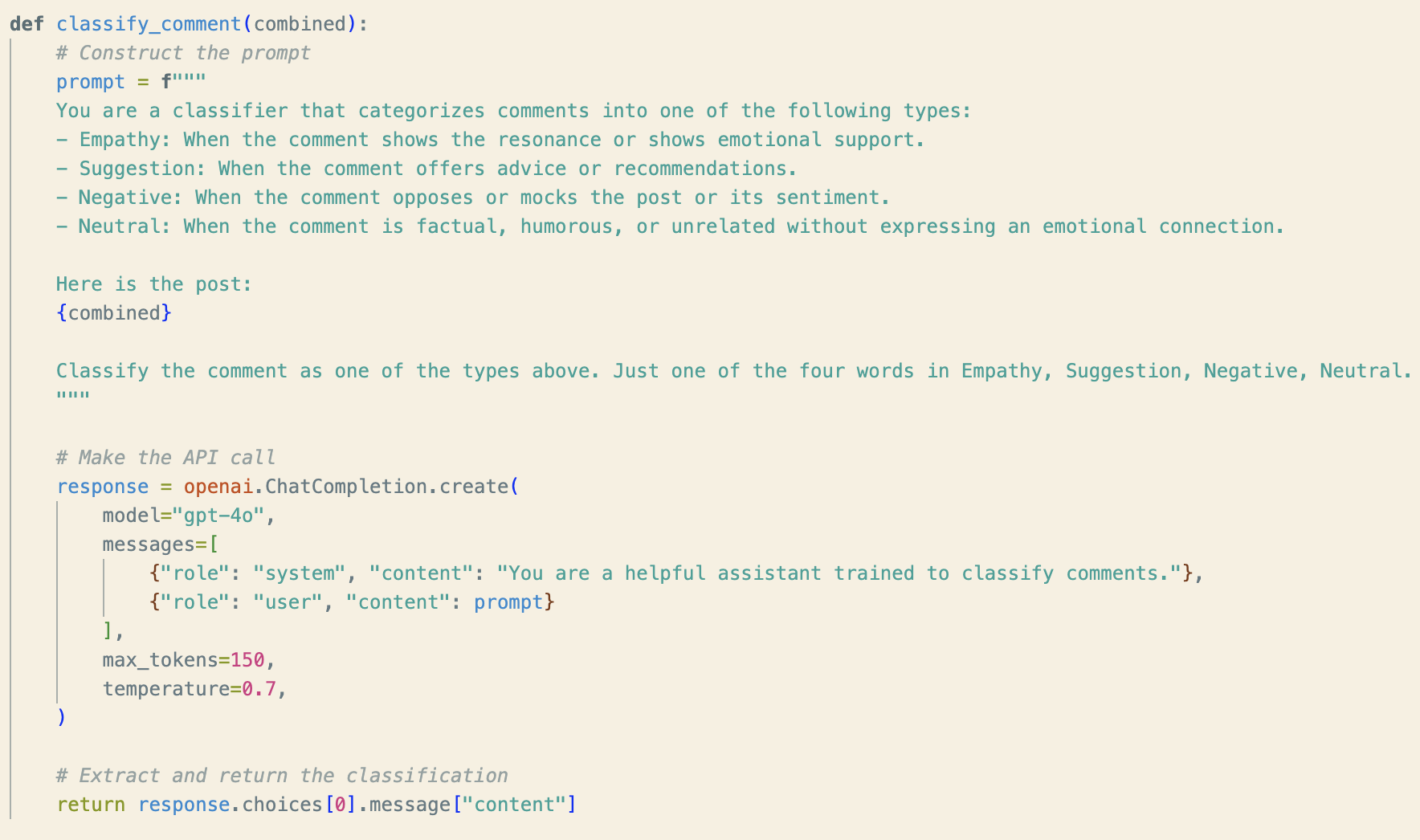
- The combined text was input into the GPT-4o model to identify the effect of each comment (detailed prompts are available in Appendix A.2), and we manually verified the LLM's reasoning to produce the labels used for classifier training.
- We developed a classifier that integrates Sentence-BERT embeddings with a Random Forest model, using SMOTE to address class imbalance and GridSearchCV for hyperparameter tuning.
- After training the classifier on the 200 labeled data points, we applied it to 1,500 randomly selected comments from each subreddit dataset. The input for these predictions was a combination of the title, post self-text, and comment.
3.3 Temporal Analysis
To examine the impact of OMHC engagement on user activities, we randomly selected 100 OPs from each subreddit community dataset and retrieved their Reddit activities, including both comments and posts. We compared the timestamps of these activities to the timestamp of the post from which each user was selected, categorizing the activities into two groups: pre-engagement and post-engagement. For each group, we calculated the average sentiment scores, average Reddit scores (defined by the Reddit website as the number of upvotes minus the number of downvotes), and the average number of comments or posts per week. Finally, we performed t-tests on the pre- and post-engagement data to determine whether there were any statistically significant differences between the two groups.
4. Results
4.1 Word Trends
We analyzed the top 5 words in each of the 9 datasets (7 OMHCs and 2 based on the r/uofm community). As shown by Figure 2, there existed both commonalities and differences in thematic focus. Certain words, such as “get” and “time,” appeared with relatively high frequency across multiple subreddits. These cross-community words indicated a baseline of shared concerns or conversational themes that transcend the specific subreddit focus.
The heatmap also revealed patterns specific to individual subreddits. For instance, terms like “que” and “la” were highly concentrated in r/sadcringe, suggesting a substantial share of Spanish-language posts. Meanwhile, words like “online,” “free,” and “watch” were more prominent in r/confusing, possibly reflecting themes related to digital engagement or escapism. The two r/uofm datasets (uofm_stress and uofm_mh) showed strong associations with terms like “class,” “student,” and “course,” emphasizing their focus on academic and mental health concerns. The word “fucking” appeared prominently in r/angry, underscoring the emotional intensity of discussions in that community.
4.2 Community-specific Sentiment and Emotion
4.2.1 Sentiment Analysis
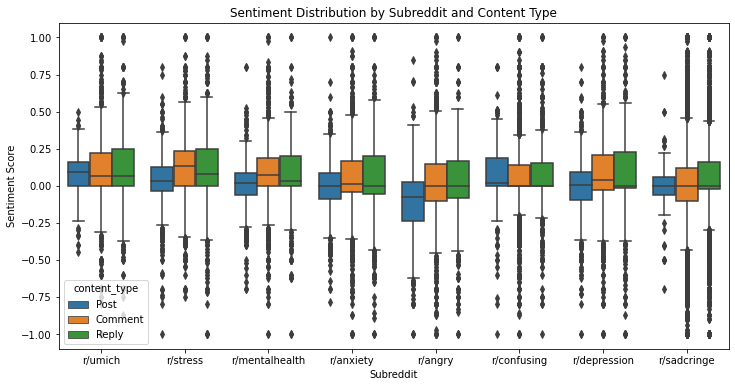
Sentiment analysis was conducted across posts, comments, and replies to evaluate the emotional tone within each subreddit. The sentiment scores, computed using the TextBlob library, ranged from −1 (strongly negative) to +1 (strongly positive). The results revealed a clear trend of increasing positivity from posts to comments and replies in most subreddits (r/confusing is the exception, with comments and replies slightly less positive than posts). For instance, in r/Stress, sentiment scores rose from 0.032 in posts to 0.127 in comments and 0.115 in replies. This suggested that while initial posts often expressed negative emotions, community interactions (comments and replies) tended to offer more positive responses, fostering a supportive environment.
Among the subreddits, r/Stress displayed the highest comment sentiment (0.127) and one of the most positive reply sentiments (0.115). Similarly, the r/uofm stress posts (uofm_stress) exhibited an increase in positivity, with post sentiment at 0.075, comment sentiment at 0.102, and reply sentiment peaking at 0.117. In contrast, r/angry had consistently lower sentiment scores across all categories, with posts at −0.109, comments at 0.006, and replies at 0.013, reflecting the subreddit's focus on anger and frustration. The divergence in sentiment scores highlighted the varied emotional dynamics across subreddits.
4.2.2 Emotion Detection
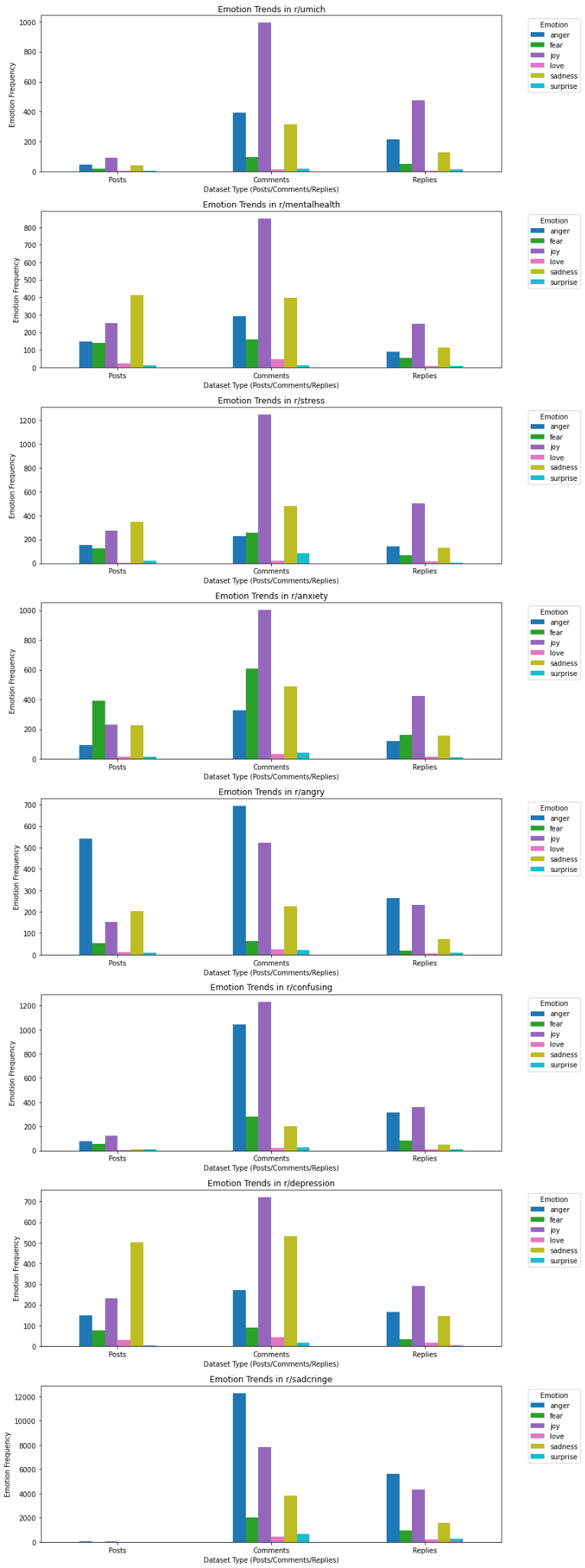
Emotion detection using the pre-trained Hugging Face model distilbert-base-uncased-emotion classified each text entry into one of six dominant emotion categories: joy, sadness, anger, fear, surprise, and love. The results showed distinct emotional patterns across subreddits and content types (posts, comments, replies).
For posts data, negative emotions like sadness and anger dominated in subreddits like r/depression (sadness: 50.8%) and r/angry (anger: 55.6%), aligning with their thematic focus. However, subreddits like r/confusing and r/uofm exhibited more balanced emotions, with joy being the most frequent in r/uofm (43.5%).
For comments and replies, joy became the dominant emotion in most subreddits. In r/Stress, joy accounted for 54.0% of comments and 58.4% of replies, reflecting the supportive and solution-oriented nature of community interactions. Similarly, in r/uofm, joy increased from 43.5% in posts to 54.2% in comments and remained high in replies (53.5%). Subreddits like r/angry maintained higher proportions of anger, but even here joy increased in comments (33.7%) and replies (38.5%), indicating a partial shift toward positivity in community interactions.
4.3 Comment Distribution Across Communities
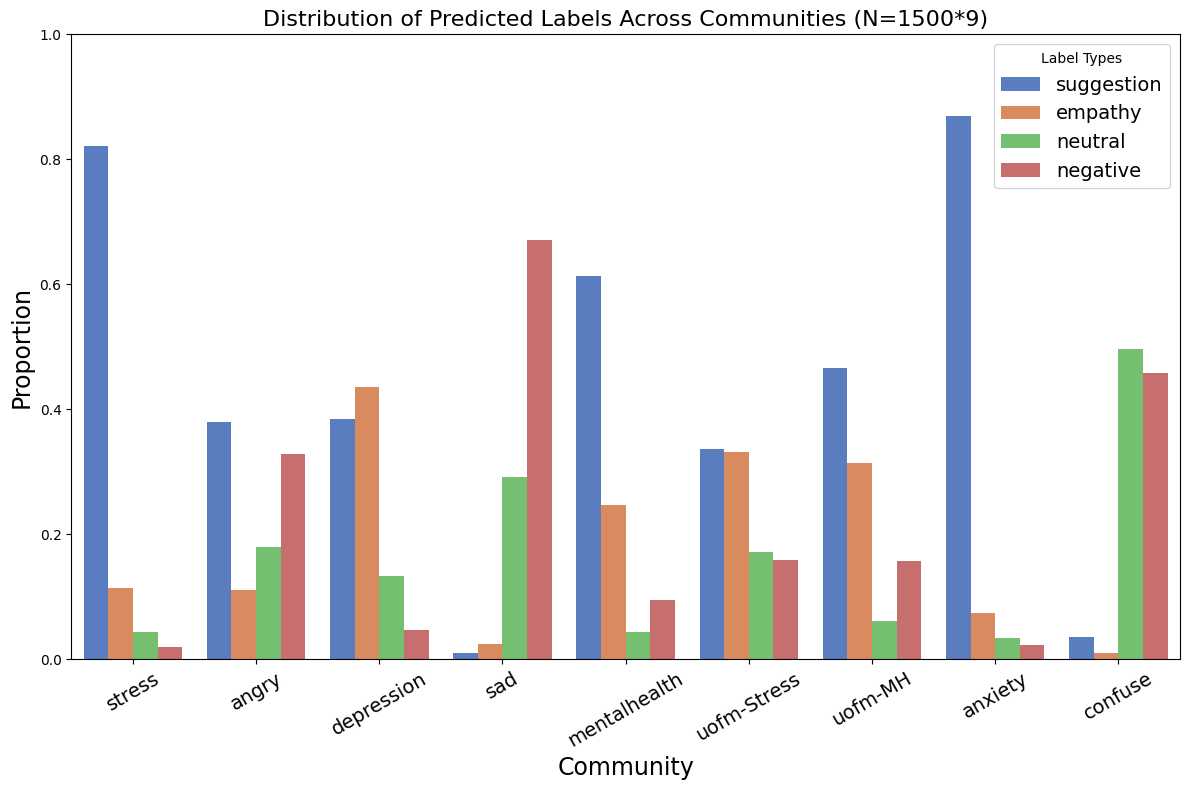
Because the comment classifier reached only moderate accuracy (0.74 on a held-out 20% validation split; Appendix A.5), we treat this section as exploratory. We return to the classifier's validity in the Discussion.
Using the four labels (empathy, suggestion, neutral, and negative), we visualized the classifier's predictions across communities in Figure 5. The distributions revealed distinct communication patterns unique to each subreddit. r/Stress and r/Anxiety showed a strong prevalence of “suggestion” labels, suggesting a focus on advice-sharing and problem-solving. In contrast, r/depression and r/sadcringe exhibited higher proportions of “negative” labels, reflecting their role as spaces for emotional expression and sharing struggles. uofm_stress and r/mentalhealth demonstrated a balanced mix of “empathy” and “suggestion,” indicating a dual focus on emotional support and practical guidance. These patterns highlighted the thematic alignment of each community while showcasing the diverse ways in which users engaged based on the specific focus of the subreddit.
4.4 Temporal Effects of Community Engagement
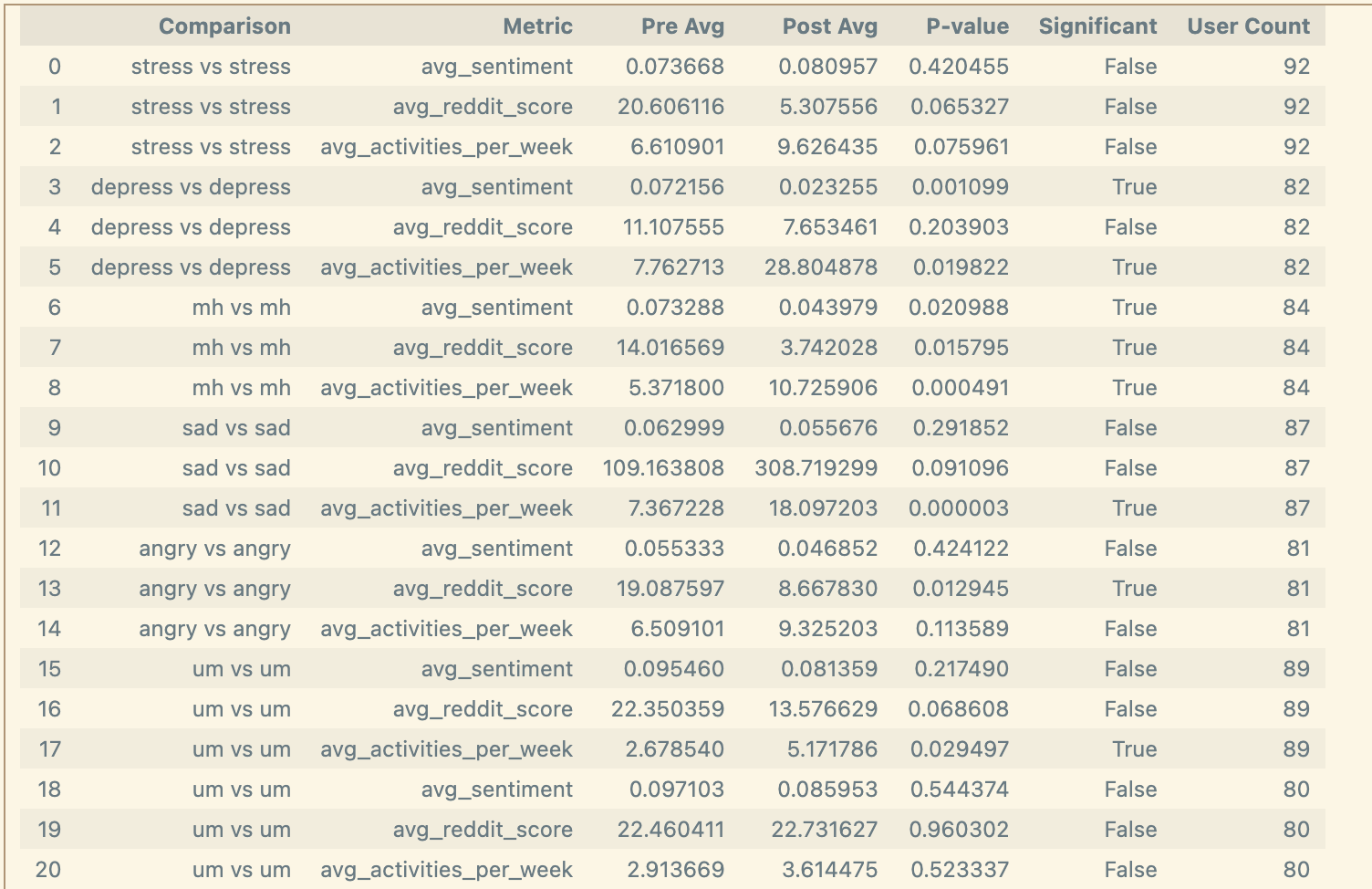
We compared randomly selected users' average sentiment scores, Reddit scores, and weekly activity frequency before and after their post in the community, counting both comments and posts. The comparison is summarized in Table 2. Entries marked with * differ significantly between the pre- and post-engagement periods (t-test), with red for decreases and green for increases.
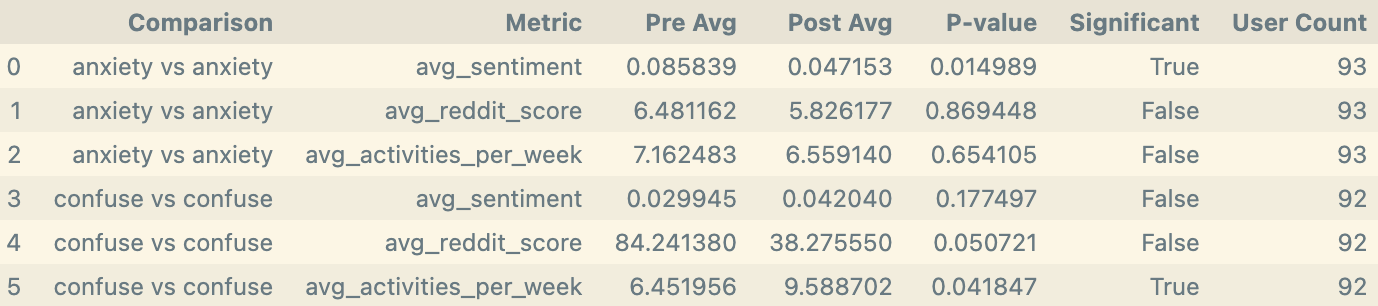
Activity frequency was higher after engagement in every dataset except r/Anxiety, and significantly so in five of the nine. Sentiment declined significantly in r/depression, r/Anxiety, and r/mentalhealth, and Reddit scores declined significantly in r/angry and r/mentalhealth. Because this is a before/after comparison without a control group, these differences are associations rather than effects of engagement itself: users may, for example, post in these communities at a point when their mood is already changing. The full p-value report is provided in Appendix A.4.
| Subreddit | PRE-engagement | POST-engagement | User number | ||||
|---|---|---|---|---|---|---|---|
| Sentiment | Score | Activity | Sentiment | Score | Activity | ||
| r/sadcringe | 0.063 | 109.16 | 7.37* | 0.056 | 308.72 | 18.10* | 87 |
| r/angry | 0.055 | 19.09* | 6.51 | 0.047 | 8.67* | 9.33 | 81 |
| r/depression | 0.072* | 11.11 | 7.76* | 0.023* | 7.65 | 28.80* | 82 |
| r/Anxiety | 0.086* | 6.48 | 7.16 | 0.047* | 5.83 | 6.56 | 93 |
| r/confusing | 0.030 | 84.24 | 6.45* | 0.042 | 38.28 | 9.59* | 92 |
| r/Stress | 0.074 | 20.61 | 6.61 | 0.081 | 5.31 | 9.63 | 92 |
| r/mentalhealth | 0.073* | 14.02* | 5.37* | 0.044* | 3.74* | 10.73* | 84 |
| uofm_stress | 0.095 | 22.35 | 2.68* | 0.081 | 13.58 | 5.17* | 89 |
| uofm_mh | 0.097 | 22.46 | 2.91 | 0.086 | 22.73 | 3.61 | 80 |
Table 2: Effects of community engagement on sentiment, Reddit score, and activity frequency (per week).
5. Discussion
5.1 Key Findings on Sentiment and Emotion
Our findings show distinct emotional shifts between posts and the responses they receive. Posts, often the initial expressions of distress or inquiry, tend to exhibit negative emotions such as sadness and anger, reinforcing the understanding that users turn to these platforms to articulate their struggles. In support-oriented subreddits like r/Stress and r/uofm, interactions show a marked increase in positivity, particularly joy, as discussions progress to comments and replies. This suggests that these communities foster constructive dialogue and provide emotional reassurance and practical solutions.
Conversely, vent-focused subreddits such as r/angry and r/sadcringe maintain higher levels of negative emotions throughout interactions, indicating that their thematic focus can perpetuate the initial emotional tone rather than mitigate it. These results suggest that community-specific norms shape the trajectory of emotional exchanges, and that vent-oriented spaces are less likely to move a conversation toward positive engagement.
5.2 Comment and Temporal Effects
Our comment classification, which combines LLM-generated labels with an SBERT-based classifier, suggests distinct communication patterns across subreddit communities, though it remains exploratory given the classifier's moderate accuracy. r/Stress and r/Anxiety demonstrate a strong prevalence of “suggestion” labels, emphasizing advice-sharing, while r/depression and r/sadcringe are dominated by “negative” labels, reflecting emotional expression. These findings highlight the thematic alignment of subreddit discussions and suggest that algorithmic models need to account for these community-specific dynamics to better reflect the nuanced nature of interactions.
The temporal analysis points in two directions: after posting in these communities, users were more active in most subreddits, while sentiment scores and Reddit scores often declined, especially in r/depression and r/mentalhealth. One reading is that engagement encourages participation while the tone of users' later contributions becomes more negative, but without a control group we cannot separate this from changes that would have happened anyway. If the pattern holds, it argues for interventions tailored to each community, such as reinforcing positivity in support-oriented spaces and mitigating sustained negativity in venting-focused ones.
5.3 Performance of Methods and Baselines
5.3.1 Emotion and Sentiment
We did not evaluate TextBlob or the emotion model against human labels, so their accuracy on this data is unknown. TextBlob's polarity scores captured the overall progression from negative to positive tone across content types, but a single polarity score cannot represent posts that mix emotions, such as anger and sadness together. The emotion model assigns one dominant label per text, which is a similar limitation for posts where emotions such as fear and anger co-occur. Fine-tuning on domain-specific data would likely help distinguish these overlapping states.
5.3.2 Comment Classification
In the comment distribution analysis, we used a combination of an LLM and an SBERT-based classifier to determine the effect of comments based on the given post title and self-text. Validation accuracy was moderate (0.74), with strong performance on empathy and suggestion but weak performance on the negative and neutral classes (F1 of 0.50 and 0.59; Appendix A.5). Two caveats follow. First, the labels themselves are LLM-generated and manually checked on only 200 comments, so they are a noisy reference rather than a definitive ground truth. Second, the subreddit-level proportions of negative and neutral comments in particular should be read with caution. We therefore use the classifier to surface broad differences between communities, not to make precise claims about any single comment or category.
6. Conclusion
6.1 Contribution
This study examines how subreddit themes shape emotional dynamics and user interactions within online communities. By analyzing sentiment shifts and comment classifications, we find that supportive subreddits foster positive emotional exchanges, transitioning from negativity in posts to increased joy in replies, while vent-focused communities tend to sustain negative emotions. Temporal analyses further show that users are more active after engaging, while their sentiment is often lower, particularly in r/depression. These findings highlight the need for community-specific algorithmic interventions to promote emotional well-being and constructive dialogue. Despite limitations in classification accuracy, the approach shows how LLM-assisted labeling and lightweight models can be combined to study support in online communities.
6.2 Limitations
Limitations of this study include potential biases in the data, such as the overrepresentation of certain emotions driven by subreddit-specific norms, which may not generalize across all online communities. Additionally, the emotion model was not validated on our data and assigns a single label per text, so domain-specific fine-tuning and evaluation are needed. The temporal analysis is a before/after comparison without a control group, so it cannot establish that engagement caused the observed changes. The comment classification approach, though exploratory, remains insufficiently tested and could benefit from refinement. Furthermore, the study is constrained by the limited Reddit data fetched, the small selection of subreddits analyzed, and the lack of access to large-scale experimental datasets, which restricts the broader applicability of the findings. Future research addressing these limitations could provide a more comprehensive understanding of emotional dynamics and engagement patterns in online communities.
6.3 Future Directions
Future work could investigate the impact of temporal factors, such as how emotions evolve over extended discussions, and analyze the influence of specific community norms and moderation practices on emotional exchanges. Furthermore, fine-tuning emotion detection models on domain-specific datasets could enhance their accuracy and applicability to diverse online platforms. Our comment classification relies on pre-defined types; future research could use unsupervised methods such as topic modeling (e.g., Latent Dirichlet Allocation) or clustering to discover comment types from the data.
References
- Thukral, S., Meisheri, H., Kataria, T., Agarwal, A., Verma, I., Chatterjee, A., & Dey, L. (2018, August). Analyzing behavioral trends in community driven discussion platforms like Reddit. In 2018 IEEE/ACM International Conference on Advances in Social Networks Analysis and Mining (ASONAM) (pp. 662–669). IEEE.
- Proferes, N., Jones, N., Gilbert, S., Fiesler, C., & Zimmer, M. (2021). Studying Reddit: A systematic overview of disciplines, approaches, methods, and ethics. Social Media + Society, 7(2), 20563051211019004.
- Urbaniak, R., Tempska, P., Dowgiałło, M., Ptaszyński, M., Fortuna, M., Marcińczuk, M., & Wroczyński, M. (2022). Namespotting: Username toxicity and actual toxic behavior on Reddit. Computers in Human Behavior, 136, 107371.
- Record, R. A., Silberman, W. R., Santiago, J. E., & Ham, T. (2018). I sought it, I Reddit: Examining health information engagement behaviors among Reddit users. Journal of Health Communication, 23(5), 470–476.
- Ribeiro, M. H., West, R., Lewis, R., & Kairam, S. (2024). Post guidance for online communities. arXiv preprint arXiv:2411.16814.
- Guo, Q., Zhang, C., Lyu, H., Peng, Z., & Ma, X. (2023, April). What makes creators engage with online critiques? Understanding the role of artifacts' creation stage, characteristics of community comments, and their interactions. In Proceedings of the 2023 CHI Conference on Human Factors in Computing Systems (pp. 1–17).
- Ayyalasomayajula, M. M. T., Agarwal, A., & Khan, S. (2024). Reddit social media text analysis for depression prediction: Using logistic regression with enhanced term frequency-inverse document frequency features. International Journal of Electrical & Computer Engineering (2088-8708), 14(5).
- Chancellor, S., Birnbaum, M. L., Caine, E. D., Silenzio, V. M., & De Choudhury, M. (2019, January). A taxonomy of ethical tensions in inferring mental health states from social media. In Proceedings of the Conference on Fairness, Accountability, and Transparency (pp. 79–88).
- Chiu, C. M., Huang, H. Y., Cheng, H. L., & Sun, P. C. (2015). Understanding online community citizenship behaviors through social support and social identity. International Journal of Information Management, 35(4), 504–519.
- Sharma, E., & De Choudhury, M. (2018, April). Mental health support and its relationship to linguistic accommodation in online communities. In Proceedings of the 2018 CHI Conference on Human Factors in Computing Systems (pp. 1–13).
- Chen, Y., & Xu, Y. (2021, May). Social support is contagious: Exploring the effect of social support in online mental health communities. In Extended Abstracts of the 2021 CHI Conference on Human Factors in Computing Systems (pp. 1–6).
- Schrauf, R. W., & Sanchez, J. (2004). The preponderance of negative emotion words in the emotion lexicon: A cross-generational and cross-linguistic study. Journal of Multilingual and Multicultural Development, 25(2–3), 266–284.
- Loria, S. (n.d.). TextBlob: Simplified text processing. Retrieved from https://textblob.readthedocs.io/en/dev/
- Savani, B. (n.d.). DistilBERT base uncased emotion classification model. Hugging Face. Retrieved from https://huggingface.co/bhadresh-savani/distilbert-base-uncased-emotion
Appendix
A.1 Sentiment and Emotional Analysis Descriptive Data
| Subreddit | Post Sentiment | Comment Sentiment | Reply Sentiment |
|---|---|---|---|
| r/sadcringe | −0.011 | 0.004 | 0.037 |
| r/angry | −0.109 | 0.006 | 0.013 |
| r/depression | −0.010 | 0.066 | 0.066 |
| r/Anxiety | −0.004 | 0.049 | 0.050 |
| r/confusing | 0.078 | 0.053 | 0.069 |
| r/Stress | 0.032 | 0.127 | 0.115 |
| r/mentalhealth | 0.010 | 0.088 | 0.070 |
| uofm_stress | 0.075 | 0.102 | 0.117 |
Table A.1: Sentiment analysis results for posts, comments, and replies across eight subreddits. Sentiment scores range from −1 (strongly negative) to +1 (strongly positive). The results indicate a general trend of increasing positivity from posts to comments and replies in most subreddits.
| Subreddit | Joy (%) | Sadness (%) | Anger (%) | Fear (%) | Love (%) | Surprise (%) |
|---|---|---|---|---|---|---|
| r/sadcringe | 31.9 | 17.0 | 39.4 | 6.4 | 1.1 | 4.3 |
| r/angry | 15.6 | 21.0 | 55.6 | 5.5 | 1.2 | 1.0 |
| r/depression | 23.3 | 50.8 | 14.9 | 7.6 | 3.1 | 0.4 |
| r/Anxiety | 23.9 | 23.3 | 9.5 | 40.4 | 1.4 | 1.4 |
| r/confusing | 45.1 | 3.3 | 28.6 | 19.8 | 0.4 | 2.9 |
| r/Stress | 29.7 | 37.6 | 16.3 | 13.6 | 0.5 | 2.2 |
| r/mentalhealth | 25.6 | 41.9 | 14.8 | 14.1 | 2.4 | 1.1 |
| r/uofm_stress | 43.5 | 19.6 | 22.0 | 9.1 | 2.4 | 3.3 |
Table A.2: Emotion distribution percentages for posts across eight subreddits, categorized into six emotions. The results highlight the dominance of negative emotions like sadness and anger in subreddits such as r/depression and r/angry.
| Subreddit | Joy (%) | Sadness (%) | Anger (%) | Fear (%) | Love (%) | Surprise (%) |
|---|---|---|---|---|---|---|
| r/sadcringe | 28.9 | 14.1 | 45.4 | 7.5 | 1.6 | 2.4 |
| r/angry | 33.7 | 14.6 | 44.8 | 4.1 | 1.5 | 1.4 |
| r/depression | 43.0 | 31.8 | 16.2 | 5.4 | 2.6 | 1.0 |
| r/Anxiety | 40.1 | 19.6 | 13.1 | 24.3 | 1.4 | 1.6 |
| r/confusing | 43.9 | 7.2 | 37.2 | 10.0 | 0.8 | 0.8 |
| r/Stress | 54.0 | 20.6 | 9.7 | 11.0 | 0.9 | 3.7 |
| r/mentalhealth | 48.3 | 22.6 | 16.7 | 9.0 | 2.7 | 0.6 |
| r/uofm_stress | 54.2 | 17.2 | 21.3 | 5.3 | 0.9 | 1.0 |
Table A.3: Emotion distribution percentages for comments across eight subreddits. Joy becomes the dominant emotion in most subreddits during community interactions, reflecting supportive and constructive engagement.
| Subreddit | Joy (%) | Sadness (%) | Anger (%) | Fear (%) | Love (%) | Surprise (%) |
|---|---|---|---|---|---|---|
| r/sadcringe | 33.3 | 12.1 | 43.4 | 7.2 | 1.7 | 2.2 |
| r/angry | 38.5 | 12.2 | 43.6 | 3.0 | 1.2 | 1.5 |
| r/depression | 44.4 | 22.2 | 25.1 | 4.9 | 2.6 | 0.8 |
| r/Anxiety | 47.9 | 17.6 | 13.5 | 18.6 | 1.6 | 0.9 |
| r/confusing | 43.8 | 5.6 | 38.5 | 10.0 | 0.7 | 1.3 |
| r/Stress | 58.4 | 14.9 | 16.4 | 7.7 | 2.0 | 0.7 |
| r/mentalhealth | 47.7 | 21.7 | 17.1 | 10.8 | 1.5 | 1.2 |
| r/uofm_stress | 53.5 | 14.4 | 24.1 | 5.6 | 0.4 | 1.9 |
Table A.4: Emotion distribution percentages for replies across eight subreddits. Replies continue the trend of positivity observed in comments, with joy remaining the most frequent emotion in subreddits like r/Stress and r/uofm.
A.2 LLM-supported Comment Classification
A.3 Removal List
stop_words = set(stopwords.words('english'))

remove_list = ['really', 'like', 'feel', 'would', 'thing', 'also',
               'even', 'one', 'anxiety', 'stress', 'sad', 'angry',
               'depress', 'confuse', 'reddit', '2024']
A.4 T-test Results of Community Engagement Effects
A.5 Classifier Training & Testing Result
X_train, X_val, y_train, y_val = train_test_split(X, y, test_size=0.2, random_state=39)
metrics = pipeline.train(X_train, y_train)
print(metrics['classification_report'])
print(metrics['metrics_df'].round(3))| Label | Precision | Recall | F1-score | Support |
|---|---|---|---|---|
| empathy | 1.00 | 1.00 | 1.00 | 13 |
| negative | 0.47 | 0.54 | 0.50 | 13 |
| neutral | 0.62 | 0.57 | 0.59 | 14 |
| suggestion | 0.92 | 0.85 | 0.88 | 13 |
| accuracy | 0.74 | 53 | ||
| macro avg | 0.75 | 0.74 | 0.74 | 53 |
| weighted avg | 0.75 | 0.74 | 0.74 | 53 |
Table A.5: Classification report for the SBERT + Random Forest comment classifier on the held-out validation set.
← Back to all projects